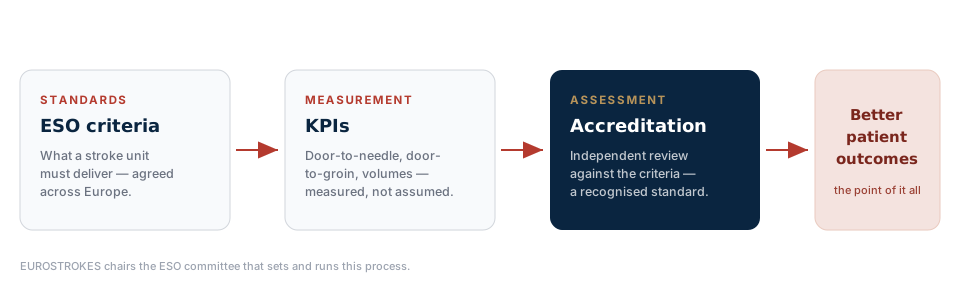
What certification actually asks of a hospital
The published criteria are identical in kind for a Stroke Unit and a Stroke Centre, differing in threshold, and they fall into seven categories, numbered as the framework numbers them: (1) a named, qualified stroke lead; (2) personnel — medical, nursing and allied-health staffing and cover; (3) general infrastructure — dedicated beds, monitoring, geography; (4) investigations — imaging and diagnostic access; (5) interventions and monitoring — the acute treatments plus physiological monitoring; (6) teaching, meetings and research; (7) numbers and quality indicators — case volumes plus a quality register. Within each, the "must" criteria are essential and have to be met in full.
The two-tier distinction is the core of the model. A Unit is organised around intravenous thrombolysis and structured acute care: 24/7 physician presence with a stroke consultant reachable, CT and CT-angiography around the clock, and a geographically distinct cluster of monitored beds. A Centre adds 24/7 mechanical thrombectomy and neurointervention — on-site or through a formal transfer network — advanced imaging, and demonstrable research activity.
What a hospital most often cannot show is rarely the equipment. The recurring shortfalls sit in categories 2 and 7: dedicated stroke-trained nursing at a defined nurse-to-bed ratio, therapy cover that survives the weekend, early dysphagia screening as a protocol rather than a habit, and enrolment in an audited quality register. And a geographically scattered set of "stroke beds" is the commonest infrastructure failure — the criteria ask for a unit, not a label.
Founding references: Ringelstein EB, et al. Stroke 2013 — PMID 23362084 · doi:10.1161/STROKEAHA.112.670430; and the certification-programme paper, Waje-Andreassen U, et al. Eur Stroke J 2018 — PMID 31008352.
Source: the programme's published recommendations and the public applicant questionnaires, 2026.
The frameworks we read
Certification criteria do not come from nowhere; behind them stands a public literature of national registries, audit reports and international measure sets. This is the shelf the work here reads — listed as public documents, with nothing drawn from unpublished work:
- RES-Q, the Registry of Stroke Care Quality — data dictionary and quality-indicator set.
- The Swedish (Riksstroke) and Danish national stroke registries' performance-indicator sets.
- The Irish National Audit of Stroke — national audit reporting, 2025.
- The German stroke-unit and stroke-centre certification criteria.
- The US Joint Commission's stroke-centre certification and its performance measures.
- The American Heart Association's Get With The Guidelines — Stroke measure set.
- The Canadian Stroke Best Practices — stroke case definitions and key quality indicators, 2021.
- The Australian work on a reliable subset of stroke process indicators.
- The Stroke Action Plan for Europe — status report, 2024.
- The published systematic reviews of national stroke registries and of expert-consensus quality-indicator development.
Source: the public quality-framework collection the certification work reads, 2026.